
Why Storage Layout Determines Whether a Service Truck Helps or Hurts Productivity
A poorly organized work truck costs time on every job. When a technician spends five minutes locating a tool that should be within arm's reach, that time adds up across every call, every shift, and every crew member on the fleet. A well-configured service truck, whether a mechanic truck, lube truck, or crane truck, is built around how the work actually gets done, not just how much equipment can be loaded onto it. Storage layout is not a finishing detail. It is a core productivity decision that belongs at the beginning of the spec process.
How Wasted Motion Drains Service Truck Efficiency
Industrial engineers have studied the relationship between workspace layout and productivity for decades. The principle is straightforward: the more frequently a tool or component is used, the closer it should be to the point of use. On a service truck or mechanic truck, this means organizing compartments around task sequences, not alphabetical order or whatever fits most conveniently.
A technician who makes three extra trips around the truck per job, on a fleet running ten trucks across two shifts, generates thousands of wasted labor hours annually. Measuring efficiency in service trucks starts with tracking how much time crews spend retrieving equipment versus performing actual work. That data almost always points back to storage layout as a primary contributor to lost productivity.
Compartment Depth, Height, and Accessibility in Service Truck Bodies
Compartment dimensions directly affect how usable the storage space is in practice. A compartment that is too deep forces technicians to remove front items to access rear items, which slows the workflow and increases the chance that tools are left out or misplaced.
A compartment that is too tall requires climbing or reaching that creates fatigue and injury risk over a full shift. The ideal compartment depth for hand tools and small parts is generally 18 to 24 inches, allowing full visibility and single-reach access to every stored item.
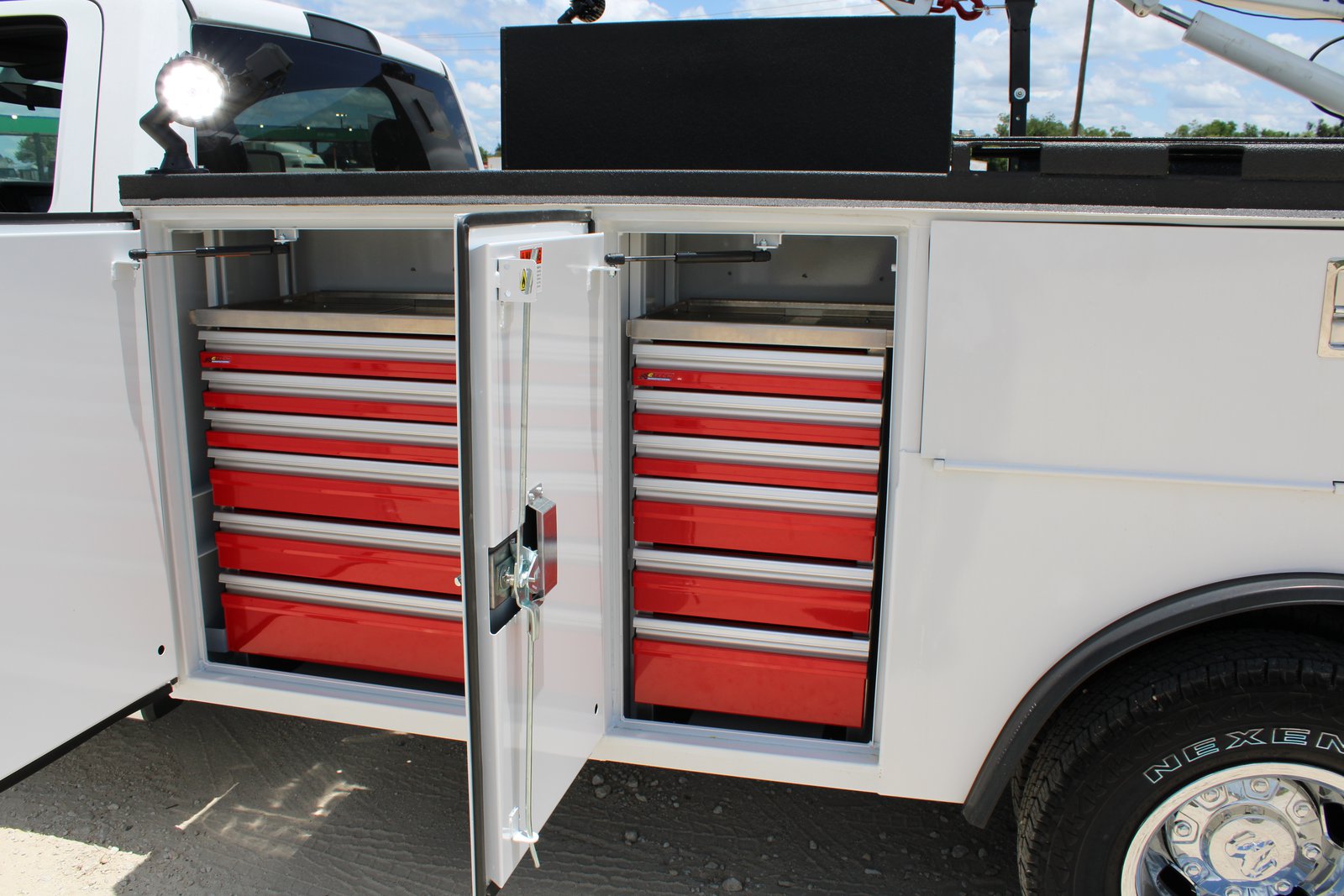
Shelf positioning within each compartment should be adjustable to accommodate different tool sizes without wasting vertical space. These dimensions need to be specified based on the actual tools and equipment each crew carries, not based on a generic catalog configuration.
Designing Storage Around Workflow in a Service Truck
The most effective storage layouts are built by mapping the technician's workflow from arrival at the jobsite to job completion. Each task sequence has a set of tools and materials associated with it. Those items should be grouped together in the same compartment or adjacent compartments.
Designing storage for efficient daily operations requires input from the technicians who will use the truck, not just the fleet managers who spec it. The people performing the work know which tools they reach for first, which items they need simultaneously, and where the current layout creates friction. Ignoring that input produces trucks that look organized on paper but slow crews down in practice.
Drawer Systems Versus Fixed Shelving in Truck Bodies
The choice between drawer systems and fixed shelving has significant implications for access speed, organization, and long-term durability. Drawer systems allow full extension access to the entire contents of a compartment without removing anything.
They also enable better organization through dividers and foam inserts that keep tools in fixed positions. Fixed shelving is simpler and less expensive but requires deeper compartments and more deliberate organization to avoid becoming disorganized over time.
On service trucks and mechanic trucks running heavy daily schedules, drawer systems generally outperform fixed shelving for frequently accessed tools. Fixed shelving remains appropriate for larger, less frequently used items where full-extension access is less critical.
Weight Considerations in Service Truck Storage Design
Storage layout decisions affect weight distribution, not just workflow efficiency. Loading heavy tools and equipment in compartments that are all positioned on the same side of the truck creates lateral imbalance that strains the suspension and creates handling issues. Stacking heavy items high in compartments raises the center of gravity and increases rollover risk on uneven terrain.
The storage layout must account for the weight of everything being stored, where it sits relative to the axle centerline, and how that weight shifts when drawers and doors are opened during operation. Upfitters who treat storage design as a purely functional exercise without considering weight placement are building trucks that compromise both safety and structural longevity.
How Jobsite Environment Shapes Service Truck Storage Needs
Storage requirements vary significantly based on where the truck operates. Trucks working in dusty, high-particulate environments need sealed compartments with gaskets to protect precision tools and electronic components. Trucks operating in wet or coastal environments need drainage provisions and corrosion-resistant hardware on all compartment doors and latches.
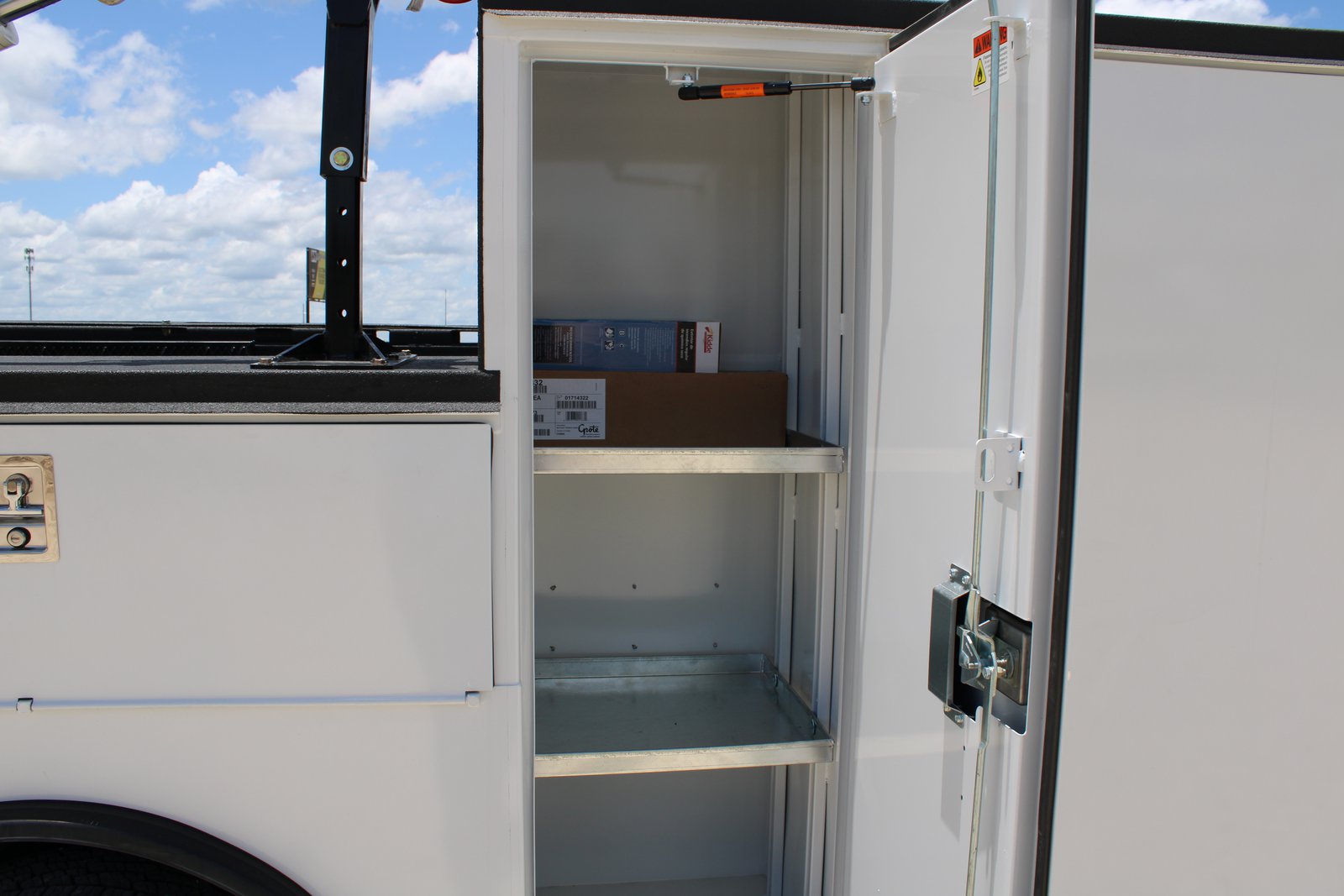
Cold climate operations require that frequently accessed compartments remain operable with gloved hands, which affects latch selection and handle design. How layout holds up in daily use depends heavily on whether the design accounted for the specific environment the truck operates in. A layout that works perfectly in a controlled shop environment can become a daily frustration on a remote jobsite in extreme conditions.
Locking Systems and Security in Truck Storage
Tool theft from work trucks is a significant and underreported operational cost. A single break-in can result in tens of thousands of dollars in lost tooling, plus the downtime associated with replacing equipment and repairing the truck.
Compartment locking systems must be robust enough to deter forced entry without being so complicated that they slow down legitimate access during a workday. Central locking systems that secure all compartments from a single point reduce the time technicians spend locking and unlocking individual doors.
High-security slam latches and T-handle locks are standard on well-built service truck and mechanic truck bodies. The security specification should match the value of the tools being stored and the environments where the truck is parked overnight.
Building Service Truck Storage That Works in the Field
At Service Truck Depot, every set of custom truck body upfits and builds we produce is configured around how the truck will be used, not just how it will look at delivery. From our purpose-built Boxcar 55 Series to fully outfitted work trucks across every application and industry, our storage layouts are engineered for access speed, weight distribution, and durability in the field.
Our team works directly with buyers to understand the workflow, the tools, and the environment before a single compartment is positioned. Contact us today to build a service truck that makes your crew faster, not slower.
Read More Posts