
Designing Service Trucks for Vibration, Dust, and Harsh Terrain
Most work trucks are built to a spec, but not every spec accounts for where the truck will actually operate. Rough access roads, airborne particulates, extreme temperatures, and constant vibration create conditions that expose every weakness in a truck body's design and construction. Service trucks, including mechanic trucks, lube trucks, and crane trucks deployed in demanding environments, face accelerated wear on every system simultaneously. A truck built to standard commercial tolerances and dropped into a harsh jobsite will not perform as well as a truck engineered specifically for those conditions.
How Vibration Damages Service Trucks Over Time
Vibration is a slow, continuous destroyer of structural integrity. On rough terrain, a work truck body experiences thousands of micro-stress cycles per mile. Each cycle works on welds, fasteners, compartment doors, electrical connections, and hydraulic fittings.
Over time, those cycles cause weld fatigue, fastener loosening, cracked panels, and failed connections that compound into significant repair costs. The damage is cumulative and often invisible until a weld cracks, a compartment door fails to latch, or an electrical system begins throwing faults.
Poor builds that lead to structural fatigue almost always share the same root cause: fabrication tolerances and mounting systems designed for pavement, not for the punishment of off-road and rough-surface operation.
Vibration-Resistant Design Features in Service Truck Bodies
Designing against vibration starts with how the body mounts to the chassis. Rigid mounting systems that bolt the body directly to the frame rails transmit every road input directly into the body structure. Compliant mounting systems using isolators or rubber-cushioned brackets allow controlled movement between the body and chassis, absorbing vibration energy before it reaches the body structure.
Crossmember spacing and gusset placement within the body also affect vibration resistance. Closer crossmember spacing and triangulated gusset configurations distribute vibration loads across more of the structure, reducing stress concentration at any single point. These design choices do not cost significantly more to implement at the build stage but add years to the operational life of the truck.
Dust Ingress and Its Effect on Service Trucks
Dust is an underestimated threat to service truck reliability. Fine particulate matter infiltrates compartments, electrical enclosures, and mechanical systems, acting as an abrasive that accelerates wear on every surface it contacts.
Precision tools stored in unsealed compartments in high-dust environments experience accelerated corrosion and abrasion. Electronic diagnostic equipment and sensitive components exposed to dust fail faster and require more frequent calibration or replacement.
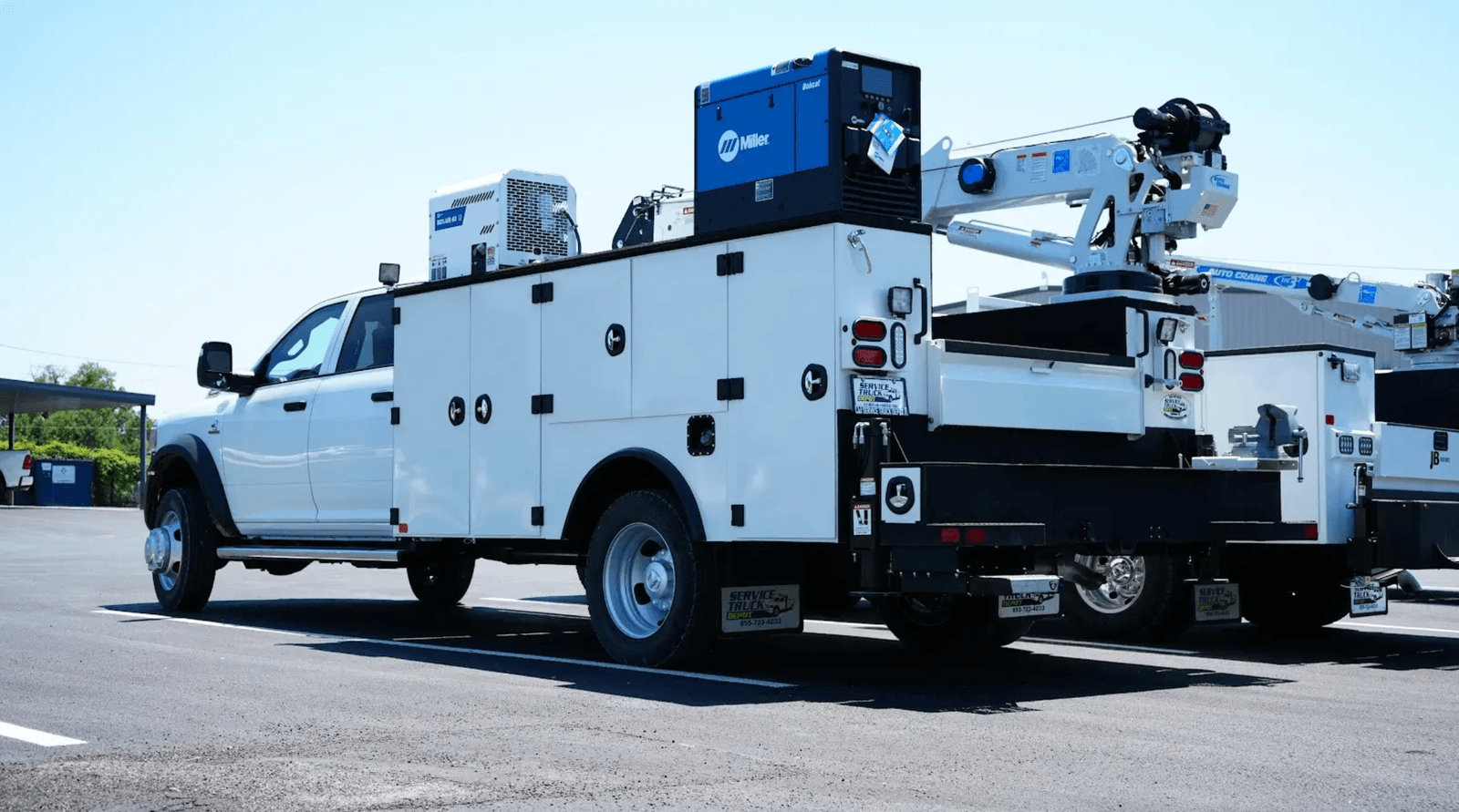
Sealing compartments with compression gaskets and routing electrical conduit through sealed fittings are basic steps that most standard builds skip. Reviewing service truck specs for extreme jobsite conditions reveals how consistently dust protection is underspecified relative to the environments these trucks actually operate in.
Compartment Sealing Strategies for Dusty Environments
Effective dust protection in a service truck body requires more than adding a gasket to a door. The entire compartment must be designed as a sealed enclosure, with attention to every penetration point: wiring conduit entries, drain provisions, hinge gaps, and latch interface points.
Compression gaskets that maintain consistent contact force around the full perimeter of the door opening provide the best seal but require precise door alignment to remain effective. Overlapping door lips that create a labyrinth seal offer a simpler alternative that tolerates minor misalignment better than compression gaskets.
Drain provisions at the lowest point of each compartment prevent water accumulation while maintaining effective dust exclusion during dry conditions. These are not luxury features on trucks working in high-particulate environments. They are minimum requirements for protecting the equipment inside.
Terrain-Driven Structural Requirements for Service Trucks
Rough terrain imposes loads on a service truck body that road-going trucks rarely experience. Uneven surfaces cause chassis twist, which is transmitted into the body through the mounting system. If the body is too rigidly attached, chassis twist creates racking loads in the body structure that it was not designed to carry.
Body-to-chassis interface design must allow enough relative movement to accommodate chassis flex without allowing so much movement that the body shifts on the frame. Ground clearance is also a design factor for trucks operating on unpaved surfaces.
Low-hanging components, exposed hydraulic lines, and underslung electrical conduit are all vulnerable to impact damage from rocks, ruts, and debris. Heavy-duty bodies built for extreme environments address these factors by routing vulnerable components within the body structure rather than below it.
Protecting Electrical Systems in Harsh-Environment Service Trucks
Electrical systems on service trucks are among the most failure-prone components in harsh operating environments. Vibration loosens connectors and chafes wire insulation against frame edges and body components. Dust and moisture infiltrate non-sealed enclosures and corrode terminals.
Heat cycling causes connector housings to expand and contract, gradually loosening the mechanical connection at the terminal interface. Proper electrical design for harsh environments uses sealed connectors rated for the application, strain-relieved wire routing that eliminates chafe points, and fused distribution blocks mounted in sealed enclosures.
Photo: Service Truck Depot
Loom and conduit protect wire harnesses from mechanical damage in areas where routing near moving components or rough surfaces is unavoidable. Electrical failures on a remote jobsite create downtime that far exceeds the cost of building the system correctly from the start.
Corrosion Protection for Service Trucks in Extreme Conditions
Harsh-terrain operations frequently coincide with exposure to corrosive environments: saltwater in coastal regions, brine on winter roads, acidic soils on mining sites, and chemical exposure at industrial sites. Corrosion protection must be applied as a system, not as a single coating.
Surface preparation before coating application determines how well any protective layer bonds and performs over time. Weld-through primers protect the base metal at joints before the outer coating is applied.
Powder coating over properly prepared steel provides a hard, chemically resistant finish that outperforms conventional paint in abrasion and chemical resistance. Undercoating applied to the underside of the body and frame provides a secondary barrier against road spray, gravel impact, and moisture accumulation in recessed areas.
Engineering Service Trucks That Go Where the Work Is
At Service Truck Depot, we build custom truck body upfits and builds engineered for the environments where our customers actually operate. From our purpose-built Boxcar 55 Series to fully configured work trucks across every application, every design decision we make accounts for vibration, dust, terrain, and corrosion from the ground up.
Our team works through the specific operating conditions of each customer's fleet before a single component is specified. Contact us today to build service trucks that hold up where standard builds fall short.
Read More Posts